This second novel in Ronni Salt’s Gunnawah series has taken the promise of the first outing and delivered on it in spades.
Salt’s first novel, Gunnawah, centred on a taut plot set in 1970s rural Australia while landing all other elements – the sense of time and place were spot on, and the three main characters were perfectly cast: newspaper proprietor Valdene (and Elvis her dog); Val’s long-time friend and collaborator, Wayne; and Adelaide Hoffman, daughter of a farming family, would-be journalist, a young woman with a lot of demons. Add to that a starring role for Gunnawah itself, a small rural town on the banks of the Murray River, full of personalities, pasts, present conflicts and politics. The Cross introduces it this way:
The town of Gunnawah sat on a sweeping bend in the Murray River, spreading in a dribble along the banks of the New South Wales border. During the winter, the frost killed the lambs and the unworthy, and in the heat-rimmed days of summer, the town wilted beneath a gauze canopy of harvested grain dust and angled sunrays that ate at the skin and bleached the soul out of anything left in the open too long.
The central thread of this novel revolves around the sale of riverside bushland by the Catholic diocese, which has some in the town excited by the potential, while others, in particular the local priest, Father Pat, are horrified. The buyer is a Sydney-based consortium that plans to develop a timeshare resort.
‘The River Shores Resort. They’re a big consortium from Sydney. They’re buying all that spare land on the Murray River the church has on the eastern edge of town.’
Back in the 1970s, timeshare was a very big thing, and this development is rolling into town with the requisite carnival: fancy brochures, elaborate gifts, smiley faces, and a disgraced TV presenter driving a bright yellow Triumph sports car to front the campaign.
Dirk Vanderboor sat waiting patiently, sitting spread out wide inside his open-top Triumph Stag looking like a shop mannequin that had been left out in the sun too long.
A bloke like Vanderboor, a flashy sort instantly noted as the type to wear a ‘shirt far too young for his body’, stands out in a town like Gunnawah, despite his promises to fit in like a coin in a slot. As does the way mayor Barry Heneghan and his wife Cheryl-Ann are carrying on over him and this proposed development. The problem for them is that standing out invariably means that some people will start sniffing around. And for readers of a certain age, the name ‘Nugan Hand Bank’ will provide a knowing frisson that those doing the sniffing are very likely onto something, even without the newspaper headlines starting to appear.
Controversy over Nugan Hand Bank accused of helping secret Liberal Party donors.
Meanwhile, Adelaide is feeling restless, not helped by her best friend Eleni being back in town on a break from Melbourne University, full of stories of student life. Adelaide’s own offer from the University of Sydney, which she has told nobody about, is a chance for the sort of freedom that anonymity in a big city can give a young woman exploring her choices. As Eleni puts it:
‘Melbourne Uni is great, I mean, I love it. You really work out who you are when you’re away from everything. You can be yourself, you know?’
Nothing is straightforward in Adelaide’s life, though – her family life complicated by a difficult mother, her personal life by a past traumatic attack. And now a growing sense of attraction to the new young cop in town is complicating what would seem to be a simple decision to take up the offer and go to university, no matter how scary the prospect of life in a big city.
The questions around the resort development have a lot of layers to them – dodgy financials, a company rapidly garnering a bad reputation, some very questionable people hanging around – and then the drowning death of Father Pat. Even though he was known to like a drink, what may have seemed like a tragic accident needs somebody to look past the obvious to the very strange timing, and the odd post-mortem results, to realise there are even more layers here.
Especially when you consider Father Pat’s vehement opposition to the resort, and the strange notebooks that Adelaide finds in his files. Nobody seems to be able to decipher them as a whole, but lots of people seem to react to individual sections.
Inside the smaller book were a series of hand-drawn images, birds and clouds, and here and there small sketches of trees. Interspersed among the sketches were a series of numbers. Occasionally, a line held a Latin phrase. The torn green paper inside the front cover had initials that seemed to have been written with ink that had been lightly smeared.
Bubbling along underneath the more obvious layers there are fissures appearing among some of the characters central to this town. Barry, Cheryl-Ann and their son Darren, and Cheryl-Ann’s twin sister Coral-Lee. The sisters are close, but Coral-Lee, the local hairdresser, is a very different personality from her forthright sister.
Unlike her identical twin, Cheryl-Ann, Coral-Lee carried herself far less assertively, worn down by the harder life she’d had to live.
Valdene and Wayne, Adelaide and her family, Tina and Kon from the Apollo Cafe and their daughter Eleni are all here again, acting as catalysts, witnesses and, just occasionally, stirrers of pots in need of agitation.
Salt works the fissures elegantly, digging around the edges, forcing them to collapse in on themselves, revealing much about life in 1970s rural Australia. In particular, about small towns where families have lived for generations, economic times are unpredictable, weather patterns are all-consuming, and knowing – and keeping – secrets is hard-fought currency. She also lays out the challenges of the draw of the ‘big smoke’ for young rural people, frightening and exciting all at the same time.
At the heart of The Cross is the consequences of trauma – intergenerational and recent – and how much more complicated it is when the abused and the abusers have families and lives that are intertwined to the point of mutual reliance. Something not so obvious in larger communities, making this also an exploration of expectation and control in small towns, and how much is ever really known about how people have been affected, until the digging hits a vein that bursts.
Salt does not flinch from an honest portrayal of the reality of those locked down, blighted existences. And how the ramifications of that continue down the generations. From the acts of the Catholic nuns and priests, to families and their constant denial and avoidance, to a whole community that knows all too well the sins of its sons and is more than happy to keep burying, digging holes that do eventually cave in.
What starts out as a typical crime story with pace and plot and a why / what / where trio of questions, quickly morphs into something more considered and carefully constructed. More about the how. Never letting go of the most wonderfully observant, wry, dry lines:
… a vast Axminister floral rug suffocating most of the floor
Right from the opening dedication:
To all the girls with burning hope on unlit paths.
Salt is digging out a path in The Cross, breaking up the layers, asking why we let these things happen and, more importantly, when and how we repair the damage.
The Cross
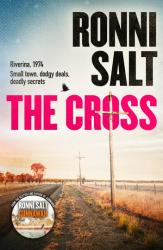
In the dying days of 1974, a mysterious yellow sports car speeds into the quiet Riverina town of Gunnawah. While the locals are initially intrigued by the stranger in their midst, nobody is prepared for what comes next.
At the town's only newspaper, the Gunnawah Gazette, cadet journalist Adelaide Hoffman starts looking into a proposed new resort development on the banks of the Murray. Her street-smart boss, Valdene Bullark, and Val's long-time friend, Wayne Trevaskis, have been around the block and they're pretty sure something shady is going down. Meanwhile, the town's only cop, raw recruit Jack Overlund, is about to learn the stranger has brought more than an oversized ego to the town.
Over the years, the echoing, heat-rimmed days of the Riverina have concealed a lot. A secretive priest. A pregnant teenager. The dark shadows of the Nugan Hand Bank. A faded TV star. A deadly shame. When big city money arrives and long-buried secrets threaten to surface, some will be forced to deal with their past and others will have to grapple with their future.
The richly comic and deeply dark companion novel to Gunnawah, The Cross is set in a time of football, meat pies, Gough Whitlam and shag-pile carpet. A quintessentially Australian crime story of ratbaggery, religion and revenge that deftly blends gripping crime with acerbically funny, moving and distinctly Australian characters.
Add comment