June Wright is one of the early writers who forged a way for the current vibrant Australian crime fiction scene.
Unfortunately the crime novels of June Wright have been largely forgotten and unavailable for many years. That situation is now being rectified, with three of the novels, featuring a range of spirited, forthright female central characters, now available in paperback (and ebook) format.
In 1948 Wright’s first novel, Murder in the Telephone Exchange, was published. Originally drafted in 1943, this story of a young telephone operator who gets involved in the investigation of the murder of an unpopular colleague followed many of the rules of Golden-Age detective fiction. Along with the investigation of the murder, Maggie Byrnes takes risks, finds love and provides an insider’s view to help solve the crime. She is the first of Wright’s strong female protagonists and we can’t help but assume that there is much of the author herself in Byrnes. Before her marriage Wright had worked in the same telephone exchange she uses as a setting, and the details of the job, deftly applied, are informed and seemingly accurate.
Following directly on from that, So Bad A Death finds Maggie now married to her policeman beau, with a small son, and looking for housing in post-war Melbourne. Searching the outlying, newly built suburbs (now very much inner-suburban territory), she finds the perfect house. Part of the ‘Hall Estate’, around which the new suburb is built, the house has never been let out despite many offers. For some reason the ‘Lord of the Manor’ character relents for Maggie and her husband, and they find themselves living in a location tailor-made for intrigue.
Intrigue in Wright’s world comes out of the mundane and domestic, the landscape and location, and the clash within families and communities. Her way of getting Maggie into the thick of it all is disarmingly simple: make her present at the point at which the possibility of murder occurs; make her curious as she accidentally eavesdrops on a conversation:
It seems ludicrous that such mundane matters should have been the cause of dragging me further into the web. And yet that is just what happened. If I had not been bent on consolidating my position with the tradespeople, I would never have chosen to cross the road at that particular moment. I would not have overheard those few words which were to make me waver in my determination to keep away from mysteries.
Wright’s family of six children is often remarked upon in interviews when she talks about the workload of writing she maintained, as are the connections between the life of her first character, Maggie, and Wright’s own life. Certainly that search for housing during the post-war shortage, and the slightly desperate search for distraction from the day-to-day sameness of childraising and housekeeping, is informed by experience. In all Wright’s books there is an element of sly and clever humour – probably not surprising for a woman whose preferred title for So Bad a Death was Who Would Murder a Baby? and (quoting from the Foreword) ‘would joke with interviewers how writing bloody murders was a good way to avoid infanticide’.
There’s also a hint of the feminist about Maggie. In conversation with the local doctor one day:
He looked at me in an odd, almost quizzical way. ‘If I said no, it would be the truth. But you wouldn’t believe it, would you? You would keep on ferreting around until you found some reason for that animosity you say the family at the Hall have for me. Let me give you some advice, Mrs Matheson, as an ordinary person as well as your doctor. It is never wise to become too curious about things outside the law. Leave it to your husband and the men of his profession.’
‘… I agree with what you say,’ I replied, trying to maintain the conversation on the same lines, ‘but unfortunately there are certain factors which place me in an awkward position. I consider that I have in my possession more information than the police have.’
Maggie is underwhelmed by the suggestion that it is her lot in life to stay home, raise the children and be a ‘good little wife’. It’s also worth noting that her husband shows no signs of insisting that Maggie conform, either, although there is a definitely a feeling that he’d prefer she stop putting herself in danger, and certainly stop finding out things before he’s had a chance to.
Some of this underlying message is, as you’d expect of the period in which these books were written, heavily overlain with a slightly arch, frequently superior tone and a slightly confusing tendency to use English terminology despite the Australian setting (woods are constantly referred to instead of bushland, for example).
The third book released, the previously unpublished stand-alone Duck Season Death, is a classic country-house, hunting-party, mysterious-death, closed-room (in this case a duck swamp) mystery if ever there was, set in the Victorian countryside, in an area that’s fictional, yet still vaguely recognisable.
It’s perhaps not surprising that it was rejected many times by publishers at the time it was written. Reader reports of the manuscript were dismissive of the formulaic feel to the novel, as well as the over-supply of red herrings, with guilt finally being allocated to one of the least likely contenders. At the time those observations would have seemed perfectly fair. There is much in Duck Season Death that exactly emulates the Golden-Age format. What is easy to miss, however, is a sense of farce, and some serious winding up of that format. Read Duck Season Death with a slightly ironic eye and there’s much to be considered.
In all of Wright’s novels re-released so far, there has been an underlying sense of fun being poked. There are the required hat-tips to Mother England, but there’s definitely something deeper here that hints at a wicked, very Australian sense of humour. Many of the characters in Duck Season Death are designed specifically to draw out the very worst of certain ‘types’ frequently found in books of this era. There’s the bumbling hotel owner, who happily relinquishes all the work, and anything difficult, to his long-suffering sister and daughter; the son of the household throwing his future away mooning around over the requisite femme fatale; the aristocratic would-bes if-they-had-any-money-to-bes; the mysterious foreigner (American); the young earnest type; the unpleasant, hard-to-avoid-thinking-he-deserved-it victim and the blow-in couple with no apparent reason for being there … Each of these characters plays a part according to the score:
‘… He wanted to go to some ghastly out-of-the-way spot, but as I pointed out to him, I can’t afford not to be seen. And even when we got to Manonetta’s,’ her voice rose incredulously, ‘he absolutely insisted upon a side table. I might just as well have been wearing something off the peg. Don’t you agree that was brutish of him?’
This is said by the femme-fatale, while the put-upon nephew of the victim, a decent sort of a chap (despite being a crime fiction reviewer … somebody that Wright seems to have enjoyed putting through the wringer) is having problems getting the death of his uncle recognised as murder rather than accidental death.
The pompous and sycophantic local doctor and policeman come in for some rather scathing commentary throughout the book, but then so does just about everybody does. It’s a universally unlikeable cast, with much blustering, dismissive, cloying and quite peculiar behaviour on show.
Duck Season Death might not stand the test of time as a straightforward country-house murder as well as some of the more well-known Golden-Age detective stories. Given that the reader will have to deal with so many unpleasant people, and, as mentioned earlier, enough red herrings to stink up the place badly, unless you get that slight sense of send-up, of farce, it won’t work as well as it should. Add that element however, and it is very hard not to laugh out loud.
All seven of Wright’s novels will be republished over the next couple of years and reading the three already re-released books is a real privilege. June Wright is one of the writers who forged the way for an Australian crime fiction scene that’s vibrant, varied and extremely engaging, and her books really deserve to be better remembered and more accessible.
Note: the Forewords to all these books are also well worth reading as they all provide incredible detail of the books, and the background of June Wright herself. Luckily we’re also able to read Wright’s own words about herself and her career in the 1996 interview with Lucy Sussex, included at the back of So Bad a Death.
Murder in the Telephone Exchange

June Wright’s debut stars feisty young telephonist Maggie Byrnes. When one of her more unpopular colleagues at Melbourne Central is murdered – her head bashed in with a “buttinsky,” a piece of equipment used to listen in on phone calls – Maggie resolves to turn sleuth. A couple of her co-workers are acting strangely, and Maggie is convinced she has a better chance of figuring out who is responsible for the killing than the stodgy police team assigned to the case, who seem to think she herself might have had something to do with it. But then one of her friends is murdered too, and it looks like Maggie might be next in line.
Narrated with verve and wit, this is a mystery in the tradition of Dorothy L. Sayers, by turns entertaining and suspenseful, and building to a gripping climax. It also offers a marvellous account of life in Melbourne in the late 1940s, as young women like Maggie flocked to the big city, leaving behind small-town family life for jobs, boarding houses and independence.
So Bad a Death

The return of Maggie Byrnes, heroine of Murder in the Telephone Exchange, finds her married, with a young son, and living in an outer Melbourne suburb. But violent death dogs her footsteps even in apparently tranquil Middleburn. It’s perhaps not that much of a surprise when widely disliked local bigwig James Holland (who also happens to be Maggie’s landlord) is shot, but Maggie suspects that someone is also trying to poison the infant who is his heir, and turns sleuth once more to uncover the culprits.
First published in 1949, So Bad a Death is June Wright’s second novel, which she originally planned to call Who Would Murder a Baby? Her publishers demurred, but under any title it’s a worthy sequel to Murder in the Telephone Exchange.
Novelist and crime fiction historian Lucy Sussex contributes an introduction to this reissue, which also includes a revealing interview she conducted with June Wright in 1996.
Duck Season Death
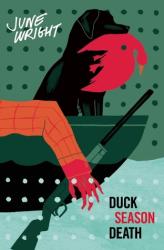
June Wright wrote this lost gem in the mid-1950s, but consigned it to her bottom drawer after her publisher foolishly rejected it. Perhaps it was a little ahead of its time? Because while it’s a tour de force of the classic country-house murder mystery, it’s also a delightful romp, poking fun at the conventions of the genre. When someone takes advantage of a duck hunt to murder publisher Athol Sefton at a remote hunting inn, it soon turns out that virtually everyone, guests and staff alike, had a good reason for shooting him. Sefton’s nephew Charles thinks he can solve the crime by applying the “rules of the game” he’s absorbed from his years as a reviewer of detective fiction — only the killer evidently isn’t playing by those rules. Duck Season Death is a both a fiendishly clever whodunit and a marvelous entertainment.
Add comment