Twenty years have passed since the brutal death of James Brandt’s beloved cousin. Will an inquiry into gay hate-crimes offer any resolution?
In 2021 journalist Michael Burge released his first novel Tank Water, a coming-of-age thriller that tackled the issue of homophobic violence, particularly from the late 1980s through to the 1990s. Protagonist James Brandt had left his hometown of Kippen in rural New South Wales as a very young man, only returning after years away when his cousin Tony was found dead under the local bridge. There were two confusing aspects to that death. First, the bridge was very near a well-known homosexual beat and had been the location of other reported attacks, although Tony was not known to be homosexual, unlike James. Second, why had Tony left the entire family farm to James? Although the wider societal question is the really big one, there’s also the question of why one lonely Kippen farm boy in every generation kills himself.
The author’s note at the back of Dirt Trap explains the trigger for the novel was the real-life New South Wales Special Commission of Inquiry into LGBTQI Hate Crimes 2021–2024. While a lot of the media reporting of that Inquiry concentrated on city-based crimes, there were a number of victims from regional areas, and in his role as a journalist, Burge spoke to many of the families:
Since the publication of Tank Water, I’ve come to realise how positioning gay-hate killing within contemporary crime fiction has a tendency to legitimise the murder of gay people as atrocities in the minds of a far bigger audience than journalism. It’s ironic, but I’m convinced this is because fiction is capable of attaching emotion to the issue, particularly when dealing with the bereaved caught up in such long-term unsolved crimes.
In Dirt Trap, James Brandt has returned to Kippen more permanently. Living on part of the family farm, near Tony’s sister Yvonne and her husband, who also care for Tony and Yvonne’s elderly mother Doris. Brandt’s father has also recently died, a fall from a tank on the family farm caused, it was thought, by a heart attack, meaning that Brandt’s connections to the area are fraying. As is his relationship with husband Dylan, who moved to Kippen with James not that many years before. The fragility of that relationship has nothing to do with Dylan, who is supportive, kind and tries to be understanding of an increasingly brittle and triggered James, who is obsessed with the findings of the NSW Inquiry, and the man he believes killed Tony.
James is a prickly, difficult, frequently confronting character. He’s also acutely aware of some of the reasons he’s struggling:
James knew his fictional ramblings were as raw as a therapy session, yet as soon as the first paragraph was out of him, a truly satisfying breath got to the very far reaches of his lungs and he could see what was really bothering him.
Tony’s killer was back in town the same week as the court hearing about his murder, and that could only mean one thing: Bobby Jones reckoned he was off the hook.
The Jones and Brandt families have been part of the fabric of Kippen for as long as anyone can remember. It’s a classic case of two multi-generational families, one small town, and all sorts of historic rivalries. James has always been convinced that Bobby killed Tony. Bobby’s departure, and the whole Jones clan’s odd behaviour since Tony’s death, seems – to James at least – to mean they have questions to answer. But nobody quite expected Bobby’s sudden return to town, accompanied by wife Kylie and teenage children Andrew and Neil. Andrew is transitioning and now goes by the name Andi. Dylan, as the principal of the high school, immediately takes this in his stride. James is unquestioning in his acceptance as well, heightened by his awareness of the bravery of being different in a small town, although it turns out that difference is not so unusual in Kippen these days, as a gay dating app reveals. Surprisingly to some, one of Andi’s loudest and most determined supporters is her father, although Andi’s grandfather proves to be nowhere near as understanding, or close to acceptance.
Dad used to say awful things about gays. So did Grandad. Drunken things, like they were proud of kicking the shit out of men like that. But once they’d known Andi wasn’t a boy, Dad stopped expecting her to join in with all that talk and would try to change the subject to make Grandad shut up. But he wouldn’t. He’d gone into a rage once about how the Joneses weren’t murderers just because a poof journalist whinged to the cops.
The depth of the problems in the Jones family really start to surface when Bobby is found dead at the foot of the water standpipe in town, as do the flaws in James’s fervent belief that Bobby killed Tony. Again the spectre of a known homosexual beat raises its head, complicated further by the ongoing drought, which means that the water collection point becomes as busy as a major city street day and night, making the discovery of a second body in the vicinity a source of major confusion.
The farmer who’d called in the body was sitting patiently in his truck. She’d go over the discovery with him again shortly, but she had no reason to doubt his story: the early morning drought news had brought him into town with his truck-mounted tank to fill up at the standpipe.
Meanwhile the outsider cop, Therese Lin, does a sterling job of dogged investigative practice, especially given the police station is now a coffee shop and residence. Instead she finds herself living in the local caravan park, next door to an investigative podcaster sent by James’s editor to work with him (not going to happen as far as James is concerned), using the pool staffroom as a police station. With limited facilities, no backup, distant forensics and a complicated web of people with plenty to hide, she works her way through these current murders trying to understand the echoes back to the time when Tony and others had died in Kippen, and those inter-family and small community tensions. But Lin is no idiot, she’s patient, and notices the little things.
Therese waved back like it was all good, because men were always unsettled by the sudden wrap-up of a little chat. If this one was worried about anything, he’d come sniffing around eventually.
Burge takes his experiences of rural life and makes them very real on the page. The observations about living through extreme drought, the complications of small-town interactions, and the nature of difference and how small gestures of acceptance can matter to an individual, sit easily within the narrative of an ongoing investigation of crimes past and present.
He’s also not afraid to make his central character a tricky individual. Readers may struggle to warm to James Brandt, although those prepared to reflect a little will see ample reasons for him being stressed, complicated, confused, and occasionally grating. It makes sense that a man who has experienced so much rejection early in life, and homophobia and the possibility that difference is potentially life-threatening, would be a bit prickly. It wouldn’t make sense to have it any other way, and it’s not just a brave move, it’s speaking truth to the facts.
Which is, when it comes down to it, exactly what Dirt Trap is all about. The inquiry into hate crimes might have bought some legal closure to some of the cases brought before it, but nothing so formal and legalistic will ever explain the emotional reality of so many lives lost because of pointless hate.
Dirt Trap
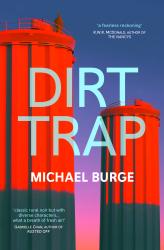
Journalist James Brandt lives in a brittle truce with his partner Dylan and his family, never talking about the homophobic attacks he exposed in his rural hometown, including the brutal death of a beloved cousin twenty years ago.
But this illusion of peace is ripped apart by the start of the state's historical gay-hate crime inquiry, and the reappearance of the Joneses, who waltz back into Kippen professing to be queer allies. Yet when one of that notorious dynasty is found dead at a local water tower, it is James who stands accused.
With an under-resourced sergeant and a tech-savvy podcaster on his heels, James refuses to trust in a police force that has proven its inadequacy with gay-hate crime. In order to clear his name and flush out which member of this remote community took justice into their own hands, he will need to expose every secret, including his own.
The gripping and heartbreaking sequel of Tank Water.
Add comment