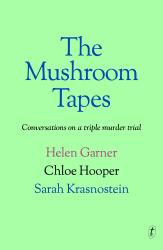
The Mushroom Tapes brings together three renowned writers of true crime: Helen Garner, Chloe Hooper and Sarah Krasnostein.
For this extraordinary book, the lone wolves became a team. Garner, Hooper and Krasnostein tracked Erin Patterson’s preliminary hearings and trial, joined the media scrum at the Latrobe Valley Law Courts, slept over in Morwell and spent countless hours in fervent discussion of the case and the themes it raises: love, hate, jealousy, revenge, marriage, money, mycology and murder.
The Mushroom Tapes is a true crime book like no other, an unputdownable record of the writers’ private conversations about their impressions from inside the courtroom. They explore the gap between the certainties of the law and the messiness of reality, their own ambivalence about the true crime genre, and all that remains unknowable about Erin Patterson.
If you read one book about how Erin Patterson was convicted of triple murder make it The Mushroom Tapes.
The Mushroom Tapes, Helen Garner, Sarah Krasnostein and Chloe Hooper
Originally, and quite obviously conceived as a podcast, THE MUSHROOM TAPES is partly a true crime exploration of a notorious case, but more than that, it's a reflection on what makes a murderer, and what makes a court case, about an event in which three much loved members of one extended family died horribly, a spectacle, and external to the case itself a nauseating farce.
The text of the book is mostly told as the relating of conversations between the three authors, in the car to and from Melbourne and Morwell (the scene of the trial), during their time waiting around outside the courtroom, in a nearby motel, coffee shop and in online and phone conversations. Whilst not always in the same place, at the same time, the three women do start out on day one of the trial with a vague idea of a podcast, or a collaborative effort in mind.
We head out of the city in a south-easterly direction. Sarah Krasnostein is at the wheel, Helen Garner and Chloe Hooper are her passengers.
We've never travelled anywhere together before. We're writers and we're friends, but this morning we're almost shy of each other, not a hundred percent sure how we're going to handle the day.
None of us wants to write about this. And none of us wants NOT to write about it.
It would be fair to say that the ambivalence, reticence, reluctance to get involved is something that they thrash out a lot, particularly as the godawful spectacle surrounding the trial started to play out. There were people in and around that courtroom that had lost their minds - it was a triple murder trial for gods sake - and some of these appalling people were treating it like we were way back in the past, when trials were the only entertainment on offer. Some people need to buy a book, watch a movie, get a bloody life...
Whilst, in the main, the majority of the spectacle was made up of breathless journalists and people with too much time on their hands, and no concept of propriety, there were also some people whose connections to the defendant were part of the bigger story of a woman who has been found guilty of killing three people, and attempting to kill a fourth, for reasons which have never really fully been explained. One of these is an "online" friend of the defendant's who the authors of this work refer to as the POA (power of attorney). She was at the trial to support the defendant:
Sarah: Remember when she told Helen she had mistaken her for a 'CWA busybody'? She apologised. I was chatting with her the other day about how we've been here so much we haven't been able to get haircuts. And she said 'I promised Erin I won't get my greys touched up until she can.'
Chloe: Of all the huge stories happening in the world, why are we all here? Climate change, the Middle East, AI about to take our jobs, the threat to democracy. But that is exactly why everyone is here. So as not to think about these things.
It is through these asides, reflections, chats between the three authors that so many of the issues in this case are raised. Some of which were undoubtedly being asked by those following and occasionally hearing things about the case, and the trial.
Chloe: In a small town, everyone's got their eye on you already. But there's a mismatch between the modest, salt-of-the-earth relatives and Erin Patterson, who seems so operatic. Is that part of the public fascination? Why do you think this has struck such a cord?
Sarah: Female poisoner.
Helen: When you said operatic, I suddenly thought of Medea.
Chloe: It's Medea in reverse though. It's not her husband's children she's alleged to have killed - it's his parents and elderly relatives.
Helen: I guess Medea in the sense that she's a huge figure. Her behaviour, if it's true, gives her operatic proportions.
Chloe: Why is the public fascinated by a female poisoner?
Sarah: It's archetypal. Adam and Eve and the apple, It's throughout myths and fairytales.
Chloe: These crime stories seem to work as modern folktales. We like it all the more if the characters are clearly good or bad, much as those old tales need a witch.
There's also reminders here, that the authors refer to, of the Azaria Chamberlain case. A mother "blamed", treated with contempt and derision because her reactions didn't fit with expectations, religion, a convenient "othering". In that case Lindy Chamberlain was eventually cleared and there's no suggestion here that the outcomes will be similar, but there is a feeling that because Patterson is female, and her behaviour often had that "operatic" or unexpected quality to it, we ended up with a witch-hunt.
Sarah: Can we talk about the difference between remorse and regret?
Helen: Raimond Gaita says that remorse is a pained, bewildered realisation of what it means to have wronged someone.
Sarah: Regret is self-interested. Remorse is a deeper thing.
Most disquieting of all is the way that the authors circle, and then zero in on the most disquieting aspects of this entire spectacle. One that caused them considerable discomfort as well - the generation of spectacle, when it should have been left to the legal process to play out a trial, in which evidence was revealed, guilt or innocence assessed, and when found guilty, sentence pronounced and closure and dignity provided to the victims, their families, and the family of the guilty party.
Okay, Erin is guilty. She murdered three people. But you know how they feast on a woman? Photographers are big-game hunters, and those are the prize shots. I saw one of them showing the security guards his series of photos: 'Yeah, we got into the van, look at this!' It was like a carnival. There was something dehumanising in that glee.
As dehumanising as the court spectators taking a celebratory, arms in the air, group photograph in the courtyard of the courthouse...
There are members of the human race who have lost their bloody minds, and some of them congregated in this place, at this trial, in disquietingly large numbers. Something that this book, in its observational and conversational manner clearly bought out into the open. As part of the process of observing the trial, and looking to write a true crime book about the trial, the three woman have instead written a story of their own discomfort, and their disquiet.
Helen: And that's another awful thing about it dragging on like this. Nobody talks or thinks about those dear people. And when Justice Beale spoke after the jury directions, when he said 'We have to remember that three people have died,' I thought he was saying in a coded way, Why doesn't everyone stop emoting and rushing around and drawing attention to themselves? There's got to be a moment of realisation of what this is actually about.