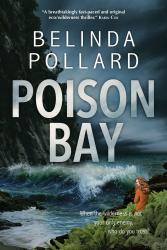
“The Maori call this place Ata Whenua—Shadow Land.”
Television reporter Callie Brown likes safe places with good coffee. But she joins friends from the past on a trek into New Zealand’s most brutal wilderness, in the hope of healing a broken heart.
What she doesn’t know is that someone wants them all dead.
Lost in every sense of the word, the hikers’ primal instincts erupt. Surrounded by people who have harbored secrets for a decade, Callie must choose the right ally if she doesn’t want to be the next to die…
Eight people were in the room when a beautiful teenager died. Ten years later, they are together again, invited to trek into the wild heart of Fiordland National Park, New Zealand. Most are not athletes, so why have they agreed to come? Old loves and old rivalries reignite as the group begins to disintegrate.
They were told their expedition would establish an alternative to the famed Milford Track. By the time they understand that its true purpose is much more sinister, it is too late. Far from the reach of outside help, they must face a deadly wilderness and a murderer alone.
Poison Bay, Belinda Pollard
Set in New Zealand, written by an Australian author, POISON BAY by Belinda Pollard is one of those novels that you just can’t help but wonder what tourism authorities reaction would be...
Located in one of New Zealand’s most rugged and beautiful locations - Fiordland - the place and the circumstances combine to create some real menace for a group of high school friends on a trekking holiday that goes horribly wrong. Starting out with a flashback to the tragic death of one of their friends, the focus switches quickly to the current day and a reunion with a difference. A group of friends, who obviously haven’t seen each other for a long time, come together to be lead through the wilderness on a one off adventure by one of their number, long resident in the area.
Even before the group heads into the bush there’s a few odd things happening, but not enough, it seems to have caused too many alarms to go off, even though many of them obviously aren’t fit, prepared, or seemingly capable of the journey they are about to undertake. Readers will probably be ringing those alarm bells though, and the idea that many of the misgivings are parked behind the desire to resolve mixed personal feelings, felt instantly worrying / odd.
Seeing most things through the eyes of television journalist Callie Brown, there’s an interesting scenario building, with the potential of a switched on, observant narrator into the bargain. The idea that old friends, unsure of each other after all these years, in the wilderness and outside their comfort zones, relying on each other to get through is a chance to look at human nature in extreme circumstances. Unfortunately, there are some inconsistencies between that scenario and the actuality of their experience. The snippets of action and outcome are quickly subsumed by massive amounts of explanatory dialogue that take great care to spell out everything, regardless of how much should have been left to the reader's observation. There’s tension between the characters that’s nearly always resolved with some mea culpa statements, and yet more explanation and there’s too much overtly convenient partnerships / pairings off which quickly seem to telegraph potential twists. Then there are the things that some characters see which others “miss” and the way that the “good guys” step into each other’s orbit too quickly to be believable or trusted.
Meanwhile the sense of extremity and threat is there with the setting, in particular, providing a much heightened sense of risk and danger than any of the human components. Whilst there was a certain sense of inevitability about some of the early twists, once they arrived and the focus turned to how to survive against the landscape and the weather as well as the expected human threat, POISON BAY did become considerably more engaging. This was helped by the focus being switched from the group lost and in trouble, to those back at the small town they set out from, being forced by relatives to start the search. The confusion about how a group of friends under the guidance of an experienced and seemingly prepared guide could have gone missing, and how the possible truth is revealed was compelling and one of the highlights of the story.
First thriller novels are often filled with the highest of highs and some elements that just simply don’t hit the mark. The idea behind POISON BAY is in interesting one, and the use of the landscape as part of the overall threat beautifully done. Missing was a lack of a subtle touch, allowing the reader to observe, conclude and engage with the characters, without the need for hammered extrapolation, explanation and reiteration.
Poison Bay, Belinda Pollard (review by Craig Sisterson)
I was very intrigued by the idea behind Brisbane journalist Belinda Pollard's debut novel - a 'who's the unknown killer in the group' adventure thriller set in one of New Zealand's most ruggedly gorgeous national parks: Fiordland. A sort of And Then There Were None in the heart of majestic Lord of the Rings locations. So there was a lot of promise behind the premise, and setting.
Unfortunately, for me, the book only semi-delivered, falling short of what it could have been. At the beginning, I couldn't quite pick what was bothering me. The story starts with a historic day in Queensland, a group of high school friends witnessing a tragedy. Then it kicks forward to Callie Brown, one of those high schoolers but now a successful television journalist, contemplating a long-planned reunion of sorts with those same friends, many of whom she hasn't spoken to in years, in the wilds of southern New Zealand. She's not sure if she, and some of the others, can hack such an arduous adventure trip. Or if she wants to confront some of the longheld mixed feelings she has about some of the others in the party.
It's a good set-up for what could be a great thriller. As the story unfolded however, I found myself regularly pulled out of the tale by bouts of unnatural and over-expository dialogue. Things were laid out for the reader - and not in subtle or subtextual ways - in the characters' conversations. At other times long-simmering misunderstandings were neatly resolved with a few 'confess all' statements that just didn't seem to ring true. The author's hand was evident a lot, rather than things seeming to naturally unfold from the set-up and characters and storylines. Things felt a little 'on the nose' and forced - and subsequently a little 'thin'.
Despite being irritated by this, and other faults, I was intrigued by the story set-up, and Pollard created enough of a 'I want to know what happens' effect, a bit of narrative drive, that I found myself persevering and continuing to turn the pages. I was rewarded as the action picked up, and death(s) were visited upon our intrepid adventurers. There were also some nice descriptions of Fiordland, and ideas of how the wilderness, for all it's phenomenal beauty, can be a very tough and unforgiving place. As those left behind begin to worry about the missing hikers, and we cut between those in town and those in the bush, Pollard did a great job of keeping me hooked on what was happening. I wanted to know how it would turn out.
There are also some interesting themes that arise throughout the story, such as the nexus between media coverage and tragedies, the complications of childhood friendships and secrets withheld, and how we can be quick to (mis)judge those around us. Overall, POISON BAY was a pretty good read that I imagine many readers would enjoy, but for me I was left with a feeling that the pieces were there for something more, and another edit or partial rewrite could have polished it to something really great.
Originally published at: http://kiwicrime.blogspot.com.au/2015/03/review-poison-bay-by-belinda-po...(link is external) and reproduced here with Craig's kind permission.
Craig Sisterson blogs at http://kiwicrime.blogsport.com.au(link is external) where he talks about Crime Fiction from his homeland New Zealand, as well as around the world. He's the man behind the annual Ngaio Marsh Awards(link is external) and an absolute powerhouse of enthusiasm and activity.