Hirsch is checking firearms. The regular police all weapons secured, ammo stored separately, no unauthorised person with keys to the gun safe. He’s checking people, too. The drought is hitting hard in the mid-north, and Hirsch is responsible for the welfare of his scattered flock of battlers, bluebloods, loners and miscreants.
He isn’t usually called on for emergency roadside assistance. But with all the other services fully stretched, it’s Hirsch who has to grind his way out beyond the Mischance Creek ruins to where some clueless tourist has run into a ditch.
As it turns out, though, Annika Nordrum isn’t exactly a tourist. She’s searching for the body of her mother, who went missing seven years ago. And the only sense in which she’s clueless is the lack of information unearthed by the cops who phoned in the original investigation.
Hirsch owes it to Annika to help, doesn’t he? Not to mention that tackling a cold case beats the hell out of gun audits and admin…
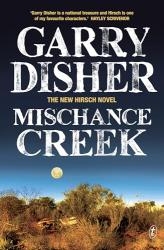
Mischance Creek, Garry Disher
Senior Constable Paul Hirschhausen and his small community are once again put to the test in the fifth of this outstanding rural noir series.
Paul Hirsch is out and about on his huge, drought-ridden South Australian beat doing firearms audits. Checking that guns are stored properly, the ammunition kept separate, not lying around on the back seats of utes as occasionally happens, and definitely not missing. A mandatory duty that always involves a lot of tea, slightly stale biscuits (the ones put away for ‘good’), and welfare checks. People out here are doing it tough – the drought is one of the worst ever, livestock are being culled in huge numbers, and everyone’s at their limits just trying to hang on. Not that Hirsch is expecting a lot of problems, it’s more welfare checks than anything else. Which is why he should have known something was up with Al Stanyer.
Hirsch brooded as he headed back the way he’d come. He could’ve stayed longer with the guy. What a life: far from the nearest town, shitty internet, bugger-all mobile phone reception. No bus at the end of anyone’s driveway out here, let alone a bank, doctor or dentist less than an hour away. If someone like Alastair Stanyer fell off a ladder or suffered from some other chronic painful or life-threatening condition, he might wait eight or twelve weeks to get an appointment.
Hirsch is a good rural cop, even if he ended up out here as punishment. He’s concerned about the people on his patch, a natural observer, and patient. Good at keeping in touch, being supportive, he knows when silence is needed. That’s not to say he’s a pushover, though, and he’s not convinced by his boss’s go-easy approach when one of the local no-hopers turned sovereign citizen starts throwing punches and pushing his luck.
He climbed to his feet, shrugged off offers of help and trudged, half-bent over, back to the police station. Got behind the wheel and called Sergeant Brandl as he set off sedately after yet another of the pissant small-town outlaws that were the bane of his existence.
Nothing is as simple as the search for Trent McRae, a man who thinks throwing punches at cops is fine, that the government and its agencies are illegitimate, that number plates are part of the conspiracy (although his suspect ute is fully registered and owned by his mum), and is a dab hand at all the crackpot ideas these people spout. He is deeply embedded in a couple of local fringe groups that seem to spend a lot of time and effort sending out threatening missives and standing around shouting pointless abuse at bank officials repossessing local farms. There are also the more dangerous aspects – violence and attacks on Hirsch are increasing, and weapons caches start appearing. Meanwhile, there’s illegal rubbish dumping, targeted road rage, and the council and its mayor making themselves desperately unpopular with everyone – not just the SovCitz bunch. Then an old accidental death / missing persons case has to be revisited as worrying connections and evidence are revealed.
There has been a steady increase in local crime fiction that addresses the sovereign citizen movement, although nothing quite like Mischance Creek. Disher, as always, is master of the art of misdirection, complicated scenarios made easy, and the slow, measured build. His deceptively laid-back storytelling style is enough to draw the reader into the action without ever making it seem obvious there’s something really big building here.
Hirsch followed Erica Woodhead back to her mother-in-law’s house, learned that Audrey McRae knew nothing about any shotgun, said goodbye to Sergeant Brandl and returned to Tiverton feeling crabbed and carping, full of gaps and absences.
The search for the now missing Trent McRae and Alastair Stanyer goes hand in hand with the firearms audit, the rubbish dumping and other more day-to-day policing tasks, alongside the personal – ongoing grief over the death of Hirsch’s father and his mother’s struggles to adjust. Then the discovery of a long-dead body, and the mystery of a dog found on the road, seem to be the tipping point. And as always, there are the little gems of observation that just nail Hirsch’s life in rural Australia, which also might hint at what’s to come.
He tossed his empty cup before shouldering through the hall’s heavy main doors. Into a warren of meeting rooms at the rear, and finally into a room normally reserved for the Country Women’s Association. Charles III reigned here, on the main wall – with his mother on a side wall, as if reluctant to cede him the throne.
Out on the edges, in communities where everything has been stripped away due to drought and years of government neglect, it’s easy and convenient to blame the fringe dwellers who latch onto a version of belonging that doesn’t fit conventional standards. But we are currently watching the playbook rolled out worldwide: the conmen, grifters, control freaks and evil people who get into communities and work them for their own ends. Be it influence or numbers, it probably comes down to distraction – when the zone is flooded with epic levels of noise, it’s hard to maintain focus on the main game – the corruption, the illegalities, the money and power grabs.
In the Hirsch series, Disher has always given voice to those who live a difficult, and different lifestyle. Battlers and the lost, people proud of where they come from, and desperate to maintain that connection into the future. The dodgy, the downright awful and the profoundly decent people who live in areas away from the cities and services. Those that thrive in that world, and those that hang on by the skin of their teeth. In Mischance Creek he’s also drawing out an explanation for why fringe dwellers are drawn to fringe ideals, and how easy those communities are to manipulate. Giving the reader something very different to consider when looking to explain or blame.