Eliza Dacey was murdered in cold blood.
Four years later, the world watched it unfold again on screen.
Producer Jack Quick knows how to frame a story. So says Curtis Wade, the subject of Jack’s new true crime docuseries, convicted of a young woman’s murder four years prior. In the eyes of Jack’s viewers, flimsy evidence and police bias influenced the final verdict…even though, off screen, Jack himself has his doubts.
But when the series finale is wildly successful, a retrial sees Curtis walk free. And then another victim turns up dead.
To set things right, Jack goes back to the sleepy vineyard town where it all began, bent on discovering what really happened. Because behind the many stories he tells, the truth is Jack’s last chance. He may have sprung a killer from jail, but he’s also the one that can send him back.
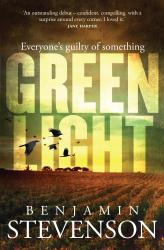
Greenlight, Benjamin Stevenson
There's a something about GREENLIGHT that feels like a non-too-subtle dig at the commercialisation of true crime. There's always been a sub-set of true crime writing that's been about the crims, their exploits, personalities and too big to be believable criminal histories. Ranging from reflective and analytical in style, to tongue in cheek, many books and programs seem to have contributed to the rise of the "celebrity criminal".
It's no surprise then that the rise and rise of the true crime investigative journalist is increasingly leaking over into the crime fiction realm, with GREENLIGHT by debut Australian author Benjamin Stevenson introducing documentary maker Jack Quick doing a major TV program on the murder of Eliza Daley. Not exactly a cold case, this was supposedly solved, the owner of the property where her body was found already convicted of her murder. Starting out with the chilling final moments of Eliza's life, as the walls of the cellar she's been held in start to "bleed", GREENLIGHT then switches to the final episode of Jack Quick's TV series, and doubt being cast on the conviction of Curtis Wade for her murder. Once Wade is released, it takes the copycat murder of his defence lawyer to trigger a crisis of confidence in Quick and his return to the small winemaking region around Birravale.
Whilst there is much to be made of the true crime industry, GREENLIGHT doesn't lose track of the core crime fiction component of solving an actual crime. In this case the murder of Eliza Daley is treated as a part cold case and part possible miscarriage of justice, with Quick starting out assuming the later, and things rapidly taking on the hue of the former. The murder of Wade's defence lawyer ramps things up substantially, with the idea that Quick's program may just have allowed a killer to walk free, but it also creates a more immediate sense about the investigation - it's a current case that is in the focus now, with echoes back to the murder of Daley.
Set in a rural location, GREENLIGHT has some street cred in terms of setting and the dynamics in which the original murder took place. A predominantly wine-growing region a few hours outside Sydney, Birravale has problems. A small community, made up of original families, and blow-in's, dealing with the complications of an incoming workforce of backpackers, tourists and now, investigative journalists, Birravale daily life revolves around the pub, but the wineries bring the people and the money in.
Adding to the mix in this novel is the "hero" of the piece as a flawed individual in his own right. An accident in their teenage years has meant that his older brother is comatose, cared for by their father, the circumstances of his brother's accident aren't clear but it's obvious that there is something very traumatic happened to them both. It has triggered bulimia in Quick, a condition that's rare in males, and the source of many complications in his life and relationships. As the story of Eliza Daley's murder plays out, Quick's personal story is revealed, balancing nicely, explaining much about his behaviour, rounding out the reader's connection and understanding of both.
Playing with this cast of characters, their connections, the things that bind them and drive them apart, there's a great sense of small community, shared and private secrets, and people searching for ways forward. The plot is fairly laid out, allowing the detective readers to solve the mysteries along the way or simply ride along with Quick as he searches for the truth. Well paced out, populated by flawed but approachable characters, set in a location that doesn't feel manipulative or convenient, GREENLIGHT is about crime, greed, money, influence, bad decisions and human frailty and nastiness.
Greenlight, Benjamin Stevenson
GREENLIGHT works extremely well as an audio title as the conspiratorial way it has been written lends itself beautifully to that platform of intimacy. In our ears it’s all quietly confessed secrets and the discovery of lies as we move around with producer Jack Quick in the shadows of a country town. This is not necessarily a sleepy town. This is wine country.
If you’ve ever stayed in an Australian wine region, you might feel that you recognize the (fictional) setting and some of the townsfolk who feature in GREENLIGHT. Wine towns ride on the back of tourism, but the locals aren’t always friendly to anyone who rides in to dabble in the business of winemaking, or to involve themselves in transactions of buying and selling wine. In Jack Quick we have someone trying to do right whilst acknowledging the wrongs that had been tactically employed along the way. He’s a curious character, and not the alpha male we normally see leading the charge in crime fiction. We’ve had enough of those. People who are able to mess up, be beaten up, and then get up again when required are way more interesting to read of.
GREENLIGHT combines the appeal of the two fastest growing forms of digital entertainment that we have right now - podcasts and audio books. Today’s time poor readers have leaped on to both of these mediums with increasing gusto in the last two years or so and it’s all to the good. GREENLIGHT is an absorbing work of fiction that gives us the required time with each character, somehow managing to gallop us past what we should have been paying our most keen attention to. Multiple voice actors are used here in the podcast excerpts that are inserted judiciously into Jack’s narrative. The lead voice actor here is brilliant at differentiating the characters he plays in Jack’s scenes, so there’s never any confusion as to whose voice it is that we are hearing.
The mental health issues raised in this novel are not often addressed in fiction in relation to the males of our species. This is quite enlightening to read of, as negotiating your everyday working life around a full blown eating disorder is just another difficulty to your day. Jack’s character and life outside of his career are fully fleshed, and the read is all the better for it.
GREENLIGHT is a polished debut work of crime fiction that offers up the trifecta of entertainment; it is engaging, topical, and satisfying. The excellent voice work in this Audible production adds much to the experience of being immersed in the struggles of Jack as he questions his own motivations and the cost of success in our entertainment obsessed world.
P.S. This reviewer lives in a wine region. Wine IS art.